 The Crypto Onur
CZ Beyond Binance: From an Exchange to Advising NationsYENİ
👁 – okunma ❤ – beğeni
Türkçe okumak için: Binance'in Ötesinde CZ
When Changpeng Zhao founded Binance in 2017, it was difficult to predict how far the company — or its founder — would end up shaping the cryptocurrency industry. Eight years later, the story has moved well beyond building a successful exchange.
Zhao's influence now runs through blockchain infrastructure, entrepreneurship, education, philanthropy, and the conversations governments are having about how nations should approach digital assets. To understand that influence, you have to look outside Binance.
From an Exchange to an Ecosystem
Binance entered a market already full of exchanges and well-funded competitors. It expanded quickly across the world, but the difference was never only size.
Over time an entire ecosystem formed around it: BNB, BNB Chain, Binance Academy, Binance Research, Launchpad, Web3 products, institutional infrastructure, developer communities. Millions of people met cryptocurrency for the first time somewhere inside that structure.
The distinction matters. Companies acquire customers. Ecosystems create participants. Binance ended up doing both.
BNB: From Utility Token to Chain
One of the most important pieces of that story is BNB. What began as a utility token tied to a single exchange became the native asset of a much broader blockchain ecosystem.
BNB Chain today carries developers, DeFi protocols, applications, gaming projects and payment infrastructure. The point is not BNB's market value; it is the network effect built around it.
When thousands of independent developers are building companies and protocols on infrastructure you helped create, your impact has already outgrown your own company.
"Funds Are SAFU"
Crypto has its own vocabulary, and one of its most recognisable phrases came directly from Zhao: Funds are SAFU.
What started as internet culture came to stand for something more serious. Binance established the Secure Asset Fund for Users — SAFU — an emergency reserve intended to protect users in extreme situations.
The phrase became a meme. The principle behind it became part of the company's identity: protect the user. In an industry where trust can evaporate overnight, that principle carries weight.
When the Role Changed
Perhaps the most interesting chapter began after Zhao stepped down as Binance CEO. For most founders, having built one of the largest companies in their industry would have been enough.
Instead, his focus widened: education, investment, mentoring founders, blockchain adoption, and increasingly, advising governments on digital assets.
Zhao has said publicly that he advises governments — both formally and informally — on crypto regulatory frameworks and on blockchain solutions for government efficiency. That is a notable reversal. A technology governments once watched from the outside is now something they want to understand, regulate and, in some cases, integrate.
From Crypto Founder to Government Advisor
Pakistan is one of the clearest examples. In 2025 Zhao was appointed Strategic Advisor to the Pakistan Crypto Council, contributing on regulation, infrastructure, education and adoption. During the visit he met Prime Minister Shehbaz Sharif and other senior officials.
With a population above 240 million, this sits well beyond the scale of an ordinary Web3 partnership. What happened there was crypto expertise entering a discussion about a nation's digital financial strategy.
The role did not stop at Pakistan. Kyrgyzstan also brought Zhao in as an advisor on digital assets and blockchain development; he met President Sadyr Japarov and joined discussions on national blockchain infrastructure and digital currencies. The country subsequently moved ahead with digital-asset initiatives, including a national stablecoin developed in collaboration with Binance.
Years ago, crypto founders were trying to convince governments that blockchain mattered. Today governments ask experienced builders for advice. That shift is one of the clearest signs the industry has matured.
Giggle Academy
The project that says the most about Zhao's current chapter has nothing to do with trading: Giggle Academy.
The idea is ambitious — deliver quality basic education to children worldwide, free. The platform uses digital learning, gamification, stories and interactive content, and states that its core educational material is intended to remain free.
The mission deserves attention, because education remains one of the world's widest inequalities. A child's access to decent schooling still depends heavily on where they were born and what their family earns.
According to the platform's own figures, Giggle Academy had reached more than 184,000 learners across 164 countries as of March 2026. Zhao has described the longer-term goal as offering free education to a billion children.
The Idea Shared by Binance and Giggle Academy
At first glance the two have nothing in common. One is crypto infrastructure; the other is education.
Underneath, they rest on a surprisingly similar idea: lower the barrier to access.
Binance helped millions of people reach a new financial system. Giggle Academy is trying to help children reach education. One deals in money, the other in knowledge, and both attempt to use technology to spread something that was previously hard to get.
Seen that way, Giggle Academy is less a change of direction than a continuation of the same approach.
"Freedom of Money"
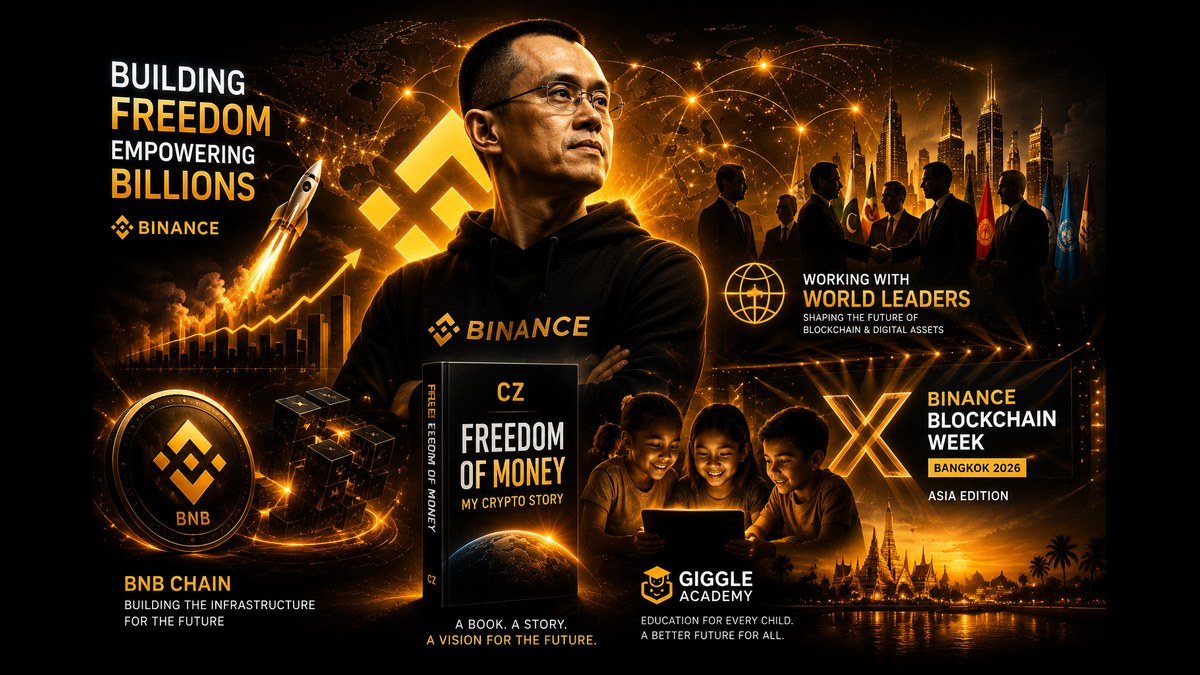
On 8 April 2026 Zhao added a new chapter with the publication of his memoir, Freedom of Money.
The book tells the story in his own words: his early years in China, his technology career, the founding and rapid growth of Binance, the difficulties that followed, and his experience with the U.S. legal system.
One of the more striking details is where part of it was written. Zhao worked on the text in federal prison, in short sessions on a prison computer.
That takes the book past the usual founder narrative. It contains not only success, but error, consequence, resilience and reckoning. The title itself summarises the idea that has followed his whole career: that people should have more control over their own financial lives.
Success Is Easy to Celebrate. Resilience Is Harder to Measure.
The most interesting founders are not the ones who never failed. They are the ones who kept building after experiencing both extraordinary success and extraordinary pressure.
Zhao has had both. He built one of the fastest-growing companies in financial technology and became one of the most recognisable people in crypto. He also went through one of the hardest periods of his life, left Binance and served time in prison.
He could have disappeared afterwards. Instead he went back to building — not by repeating what he had already done, but by moving into new areas.
The Picture Is Now Larger Than Binance
Describing Zhao simply as "the founder of Binance" is technically correct and increasingly incomplete.
The story today includes Binance and the globalisation of crypto trading, BNB and the growth of a blockchain ecosystem, SAFU and a culture built around user protection, support for founders and builders, advisory work with governments on digital assets, free education through Giggle Academy, and the personal accounting set down in Freedom of Money.
The pattern connecting these chapters is consistent: build something, open access to it, take it global, move to the next problem.
From One Startup to National Scale
In 2017 a crypto exchange was launching. Eight years later, governments were appointing its founder as an advisor on digital assets.
That transition says something about Zhao, and considerably more about crypto. Bitcoin moved from internet forums to corporate balance sheets. Stablecoins moved from exchanges into discussions about global payments. Blockchain stopped being an experiment and became part of conversations about national infrastructure.
Next Stop: Bangkok
The crypto community gathers again in November. Binance Blockchain Week 2026 takes place on 28–29 November in Bangkok, at the Queen Sirikit National Convention Center.
The theme is a single word that summarises the past decade: EVOLVE.
Crypto evolved. Binance evolved. Governments' attitude to blockchain evolved. And along the road from programmer to founder, investor, educator, author and government advisor, Zhao evolved too.
The one thing that did not change is the habit underneath all of it: he kept building.
@cz_binance — will we see you in Bangkok?
ReachX: Build Your Own Reach
This section is our own announcement.
Reach is not only a concern for large companies. How many people actually see a post you publish on X is the same question at a smaller scale.
ReachX is a Telegram app that approaches it through mutual discovery. You open and read other people's posts and leave honest feedback; every Reach you earn shows your own post to one more real person. No bots, no purchased engagement, no forced likes or follows.
Joining is free: xreach.cryptoonur.xyz
Bu yazı, X üzerindeki gündem takip edilerek yapay zekâ desteğiyle hazırlanmıştır. Bilgiler doğrulanmadan yatırım kararına esas alınmamalıdır. Yatırım tavsiyesi değildir.